28-Day Sanctuary · Session 8
Three Jewels
Session 8 of the free Light of Dharma contemplative journey, combining Buddhist wisdom, daily-life reflection, and a gentle practice.
Welcome back, traveler. Take a seat, pour yourself a warm cup of tea, and breathe out the residues of the past week. You have crossed the threshold of the first seven days, exploring the architecture of reality. Today, we enter Week 2: The Path of Virtue ($Sīla$). Before we can train our steps in ethical harmony, we must look at where we place our trust. Today, on our eighth day, we examine the foundation of all Buddhist practice: The Three Jewels.
Day 8: The Foundation of Trust: The Three Jewels ($Buddha$, $Dhamma$, $Saṅgha$)
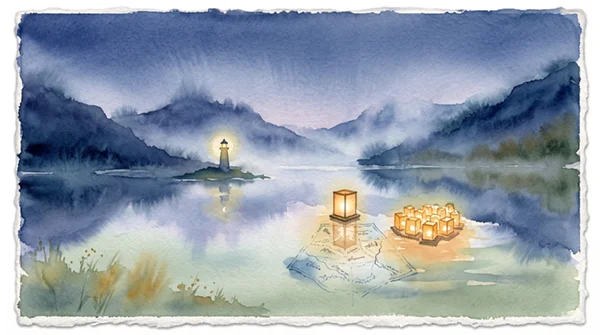
When people enter the Buddhist path, they participate in an ancient custom called "taking refuge." For an absolute beginner, this phrase can sound intimidating, perhaps evoking images of a cultish surrender of intellect or blind, dogmatic faith.
But the Buddha explicitly discouraged blind belief. In our tradition, taking refuge is not about hiding from reality or checking your mind at the door. It is an act of clear-eyed realism. It means recognizing that the world is turbulent, and intentionally choosing a safe harbor over things that cannot protect you.
This safe harbor is composed of three interconnected nodes, known as The Three Jewels ($Tiratna$):
- The Buddha: The Guide. Taking refuge in the Buddha means trusting the historical teacher as a fellow human who woke up, and recognizing that you have that exact same potential for awakening (Buddha-nature) inside you.
- The Dhamma: The Map. This is the truth of reality and the body of teachings the Buddha left behind. Taking refuge in the Dhamma means treating the teachings as a practical medicine to be tested and used, not just admired.
- The Saṅgha: The Companions. This is the community of fellow practitioners. Taking refuge in the Saṅgha means trusting the wisdom of those who walk beside you, acknowledging that we cannot walk this ancient highway entirely alone.
The Parable of the Mountain Shelter
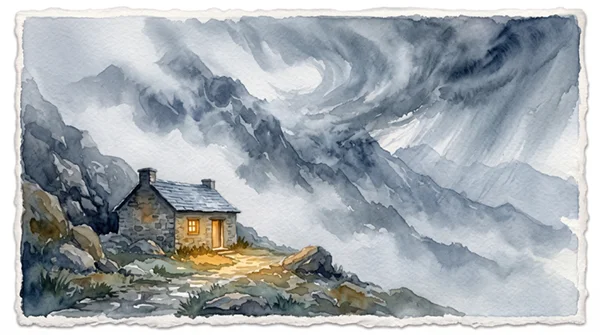
To understand the visceral nature of refuge, let us look at an old story from the early commentary traditions:
A weary merchant was crossing a vast, unfamiliar mountain range at twilight. Suddenly, a violent storm rolled over the peaks. The wind howled through the passes, freezing rain fell in blinding sheets, and the earth beneath his feet turned into mud. Shivering uncontrollably, completely lost in the dark, the man stumbled blindly along a cliff edge, terrified of falling. Through the darkness, he caught a glimpse of a steady light. Crawling toward it, he discovered a sturdy stone cottage built into the side of the mountain. Inside sat a wise mountain guide beside a blazing hearth, holding an old, well-tested trail map. The guide pulled the frozen traveler into the warmth, wrapped him in a dry blanket, and shared a bowl of hot soup. The traveler did not bow down to the cottage as a god; he simply sat inside its walls because they were solid enough to withstand the howling gale outside. He rested, trusting the guide and studying the map so he could hike out safely when dawn arrived.
The stone cottage is the Saṅgha, the map is the Dhamma, and the wise host is the Buddha. Refuge is simply getting out of the freezing rain.
Modern Refuges: Grounding in a Chaotic World
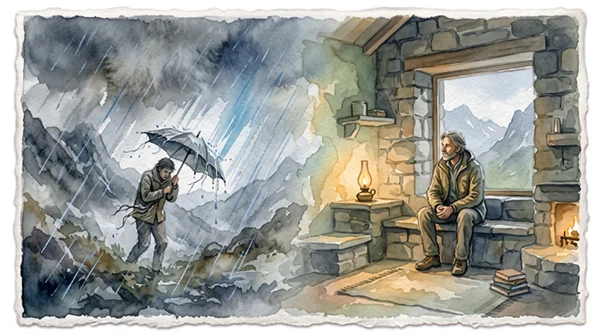
Let us bring this down to earth. Where do we seek refuge during a modern, chaotic week?
Imagine you have just had a devastating day at work. A project failed, your supervisor blamed you, and the sheer pace of modern expectations leaves you feeling raw, anxious, and deeply exposed.
When that inner storm hits, notice what your mind automatically reaches for to feel safe. For many of us, we take refuge in our habits: we open a food delivery app and order a massive comfort meal; we pour a heavy drink; we scroll online shopping sites for a hit of dopamine; or we desperately seek validation and approval from friends, texting multiple people to ensure we are still liked.
But do these modern shelters hold up? The comfort food leaves us sluggish; the drink wears off into a headache; the online purchase brings a fleeting rush followed by a credit card bill; and human approval is as shifting and fickle as the wind. They are flimsy umbrellas in a hurricane.
Now, imagine that instead of those habits, you take refuge in the Three Jewels. You sit quietly and remember that your true worth isn't tied to your corporate output—you possess an unscratchable awareness (refuge in the Buddha). You reflect on the law of impermanence, knowing this bad day is just weather that will pass (refuge in the Dhamma). And perhaps you text a mindful friend or attend a local meditation group where people listen without judgment (refuge in the Saṅgha). You have stepped into a structure built of stone.
Your Reflection Task for Today
Today, let us investigate our hidden shelters with radical, gentle honesty.
The "Audit of Refuges" Exercise: Sometime today, take out a piece of paper or open a blank note on your phone. Write down the answer to this question: "When I feel anxious, rejected, or completely exhausted, what is the very first thing I run to for comfort?" Look closely at your answers (be it work, food, shopping, substances, or social media approval). Contemplate their stability. Ask yourself: Can this shelter actually protect my mind when life gets truly difficult? Compare their fragile nature to the boundless, historical, and tested safety of the Teacher, the Teachings, and the Community.
Rest comfortably in your harbor today. I will meet you here tomorrow, as we begin building our first wall of protection: the commitment to protect life.