28-Day Sanctuary · Session 1
The Physician's Gift
Session 1 of the free Light of Dharma contemplative journey, combining Buddhist wisdom, daily-life reflection, and a gentle practice.
Welcome, traveler. Take a breath, let your shoulders drop, and arrive fully in this moment. I am glad you are here.
By choosing to turn your attention inward, you are embarking on a journey not of conversion or blind belief, but of profound discovery. You do not need to become a "Buddhist" to benefit from the Dharma; you only need to be human, curious, and willing to look honestly at your own mind.
Let us begin our first day at the very beginning—with the foundation upon which the entire path rests.
Day 1: The Physician's Gift
Introduction to the Four Noble Truths
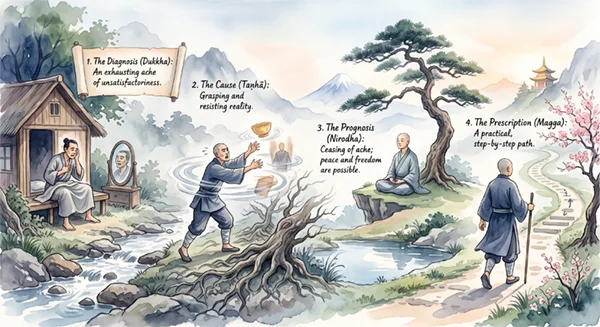
When we look at a statue of the Buddha, it is easy to mistake him for a distant deity demanding worship. But the Buddha never claimed to be a god, a savior, or a prophet. Instead, the ancient texts often describe him using a much more intimate, grounded title: The Great Physician.
Imagine waking up with a persistent, exhausting ache. You don't need a judge to condemn you, nor a mystic to cast a spell; you need a doctor. You need someone who can accurately diagnose what is wrong, explain why it is happening, assure you that a cure is possible, and prescribe a clear treatment plan.
This is exactly what the Buddha did for the human condition through The Four Noble Truths:
- The Diagnosis (Dukkha): There is a pervasive friction, unsatisfactoriness, or "ache" in life.
- The Cause (Taṇhā): This ache is caused by our deep-seated habit of grasping, resisting, and demanding that reality be different than it is.
- The Prognosis (Nirodha): This ache can completely cease; a state of profound peace and freedom is entirely possible.
- The Prescription (Magga): There is a practical, step-by-step path of living and training the mind that leads directly to that freedom.
The Parable of the Poisoned Arrow
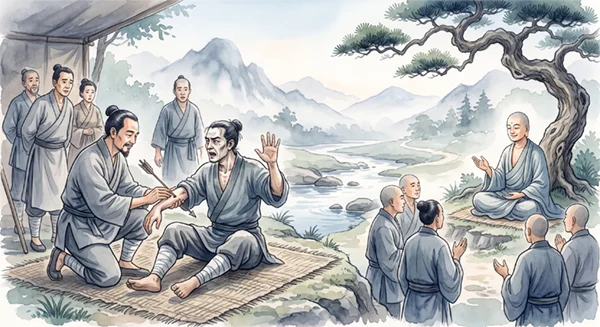
To understand why the Buddha focused so strictly on practical healing rather than abstract philosophy, consider one of his favorite stories:
A man was wounded by an arrow thickly smeared with poison. His frantic friends and family hurried him to a skilled surgeon. But as the doctor prepared to extract the arrow, the wounded man stopped him.
"Wait!" the man demanded. "Before you pull this out, I must know: Who shot me? Was he a warrior, a priest, or a merchant? What is his family name? Is he tall or short? And what kind of bow did he use? Was the arrow fletched with vulture feathers or heron feathers?"
The Buddha smiled gently at his disciples and said, "The man would die before he ever learned the answers to those questions. My teaching is not about how the universe was created, or whether the soul lives forever. My teaching is simply this: You are wounded by the arrow of suffering. I am here to help you pull it out."
The Four Noble Truths are not doctrines to debate; they are the tools to pull out the arrow.
Bringing the Dharma to Work: The Overflowing Inbox
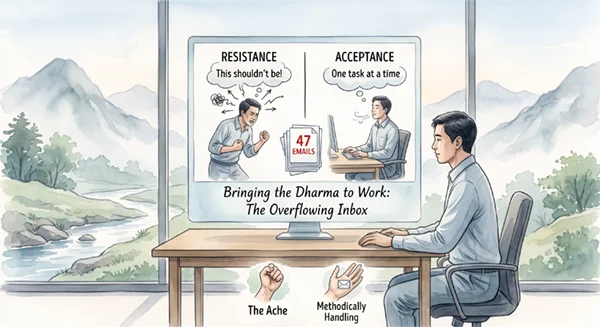
How does this look in our modern, fast-paced world?
Imagine you sit down at your desk on a Monday morning. You open your computer, and you are instantly greeted by 47 unread emails, a demanding message from your boss, and a calendar packed with back-to-back meetings. Your chest tightens. Your jaw clenches.
Let’s apply the Physician’s Gift right there in your office chair:
- The Diagnosis: You feel a sharp spike of anxiety and irritation (Dukkha).
- The Cause: If you look closely, the anxiety isn't just caused by the emails themselves—it is caused by your internal resistance (Taṇhā). A voice inside is screaming, "This shouldn't be happening! I can't handle this! I need this day to be calm!" You are grasping for a peaceful morning that does not exist in reality.
- The Prognosis: Freedom (Nirodha) is realizing that you can experience a busy day without letting your inner peace be destroyed.
- The Prescription: You take a conscious breath, accept that the morning is chaotic, and methodically handle one email at a time (Magga).
By dropping the internal fight against reality, the suffering evaporates, leaving only the tasks at hand.
Your Reflection Task for Today
Today, I invite you to play the role of the physician for your own mind.
The "Check-In" Practice:
Three times today—perhaps when you check your phone, before you eat a meal, or while stuck in traffic—pause for just ten seconds. Take a deep breath, soften your shoulders, and ask yourself:
"Is there any friction or resistance in my mind right now? What am I wishing was different?"
Simply notice it without judgment. You are learning to recognize the diagnosis so that, together, we can apply the cure.
Go gently into your day. I will meet you here tomorrow.
Continue with established sources
Further reading
Open complete translations and specialist reference material for deeper study.
- SN 56.11 · Setting in Motion the Wheel of the Dhamma
SuttaCentral · Bhikkhu BodhiRead the complete discourse alongside its canonical collection context.
- MN 63 · The Shorter Discourse to Mālunkyaputta (The Poisoned Arrow)
SuttaCentral · Bhikkhu SujatoRead the complete parable of the poisoned arrow and the Buddha’s rationale for setting aside speculative metaphysics.