28-Day Sanctuary · Session 14
The Heart of Generosity
Session 14 of the free Light of Dharma contemplative journey, combining Buddhist wisdom, daily-life reflection, and a gentle practice.
Welcome back, traveler. Take a gentle breath, feel the ground beneath you, and let your awareness rest right in the center of your chest. Today marks the exact midpoint of our 28-day journey together. Yesterday, we allowed the heart to bask in the warm, radiant sunshine of loving-kindness ($Mettā$). Today, we explore what happens when that beautiful warmth encounters a world that is heavily burdened by pain.
Day 14: The Quivering Heart: Cultivating Compassion ($Karuṇā$)
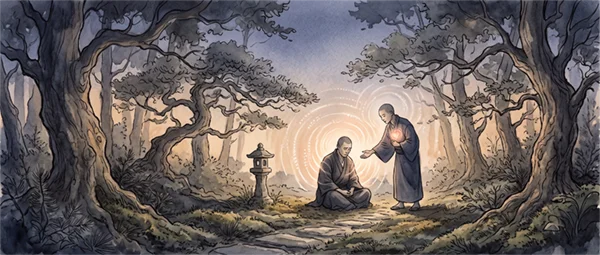
In our previous session, we introduced the Four $Brahmavihāras$—the sublime abodes of the heart. The second of these celestial dwellings is $Karuṇā$, which translates to compassion.
In the ancient Pali scriptures, $Karuṇā$ is beautifully defined not as a concept, but as a physical, resonant movement: it is the quivering or trembling of the heart in response to suffering.
To truly understand compassion, we must distinguish it from two states that masquerade as it:
- It is not pity: Pity looks down on someone from a distance, feeling a cold sense of superiority or separation ("Poor things, I'm glad that isn't me"). Compassion looks straight into the eyes of another, recognizing an equal.
- It is more than just empathy: Empathy is simply mirroring another person's emotional state—feeling sad when they feel sad. Compassion takes that shared resonance and transforms it into an active, courageous force. It is the deep, cellular wish: “May you be free from this pain, and how can I help you carry it?”
The Bodhisattva and the Starving Tigress
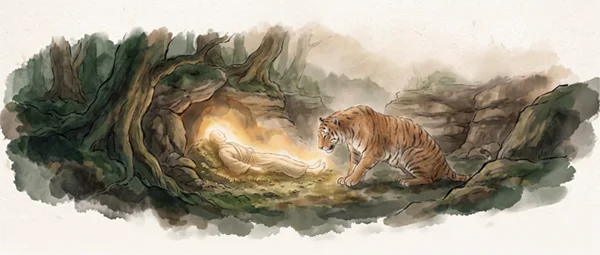
To illustrate the uncompromising depth of $Karuṇā$, the early Buddhist scriptures tell many stories of the historical Buddha in his previous lives, during his ages of training as a Bodhisattva (an awakening being committed to saving all lives):
Long ago, the Bodhisattva was walking through a dense forest with his disciple when they peered down into a deep, rocky ravine. At the bottom lay a majestic tigress. She was skeletal, dehydrated, and utterly exhausted, having just given birth to a litter of tiny cubs. Maddened by extreme hunger and driven by primal desperation, the tigress was eye-ing her own newborn babies, preparing to devour them just to survive. The Bodhisattva’s heart shook violently with compassion. He turned to his disciple and said, "Quickly, run back to the village and see if you can find any scraps of meat or food to save this mother!" > As the disciple rushed off, the Bodhisattva realized that the village was hours away; by the time help arrived, the cubs would be dead. Looking down at his own physical form, he thought: "This body is temporary, changing, and ultimately insubstantial. If I can use it right now to prevent a mother from committing an act of horror and to save her innocent young, it is the highest use of this life." Slipping quietly down the ridge, the Bodhisattva laid himself down peacefully in front of the dying tigress. In that final act of radical selflessness, his sacrifice sustained the family, allowing both the mother and her cubs to live.
While we are not asked to make such literal, legendary sacrifices, this traditional story challenges us to ask: Where do we draw the boundaries of our comfort when someone else is in distress?
Sitting by the Bedside: Leaning into the Pain
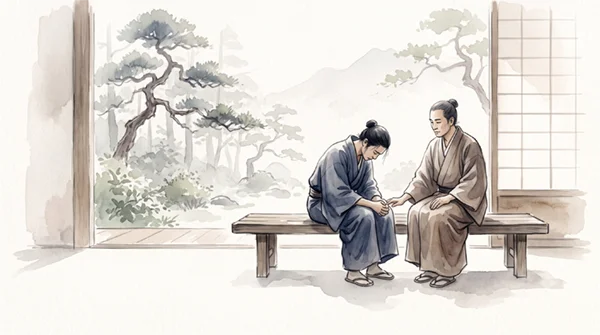
In our modern society, we have become highly skilled at turning away from discomfort. When a friend goes through a traumatic divorce, or a coworker loses a family member, we often find ourselves retreating. We tell ourselves, "I don't want to bother them," or "I just wouldn't know what to say." But if we look deeply, we aren't protecting them; we are protecting ourselves from the awkward, heavy feeling of their grief.
Practicing $Karuṇā$ means having the bravery to lean in. Imagine visiting a friend who is weeping in a hospital waiting room. Instead of offering hollow cliches like "Everything happens for a reason," or trying to fix a situation that cannot be fixed, compassion allows you to simply pull up a chair. You drop your armor. You look at their tears, let your own heart quiver with their sadness, and say: "I am right here with you. You don't have to carry this alone." By refusing to run away from their suffering, you give them the rarest gift on earth: sanctuary.
Your Reflection Task for Today
Today, we are going to look past the screen of our own thoughts and tune into the unspoken burdens of those around us.
The "Bearing Witness" Practice: Sometime today, deliberately look for one person who is visibly struggling. It might be a family member clenching their jaw in stress, a coworker looking thoroughly exhausted at their desk, or a cashier at the grocery store dealing with a rude customer. Instead of ignoring them or moving past quickly, stop. Offer them your full, non-judgmental presence. If it is a stranger, send them a silent wave of mental support: “I see your weight. May you find ease.” If it is a colleague or loved one, step into their space and offer a concrete gesture—a warm cup of tea, a word of appreciation, or simply ask, “How are you holding up today?” and truly stay to listen.
Let your heart quiver today. It is not a sign of weakness; it is the cracking open of your true awakening nature. Go gently, and I will see you tomorrow.