28-Day Sanctuary · Session 3
Roots of Thirst
Session 3 of the free Light of Dharma contemplative journey, combining Buddhist wisdom, daily-life reflection, and a gentle practice.
Welcome back, friend. Sit comfortably, release the tension in your shoulders, and take a slow, deep breath. Yesterday we explored the bumpiness of life—the inherent friction called $Dukkha$. Today, the Great Physician points us directly to the root cause of that friction.
Day 3: The Second Truth: The Roots of Thirst ($Taṇhā$)
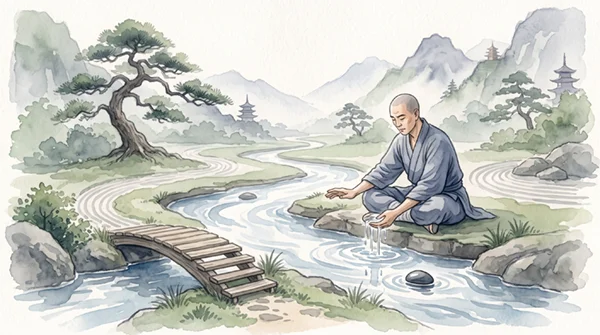
If life feels like a bumpy ride, we must ask: Who is pulling the wheel out of alignment? The Buddha's second insight is beautifully precise. The cause of our friction is a deep, instinctual drive called $Taṇhā$, which literally translates from the Pali language as "thirst."
This is not a healthy physical thirst for water. It is an unquenchable psychological thirst—a feverish demand that reality conform to our personal wishes. This thirst fundamentally shows up in two ways:
- Grasping: When we experience something pleasant, $Taṇhā$ causes us to cling to it, terrified that it will leave. We demand that the pleasant moment stay exactly as it is forever.
- Aversion: When we experience something unpleasant, $Taṇhā$ causes us to panic, desperately fighting to push it away or demanding that it immediately vanish.
We suffer not because life changes, but because we are violently resisting the fact that life changes. We are thirsty for a static, perfect world that does not exist.
The Parable of the Monkey Trap
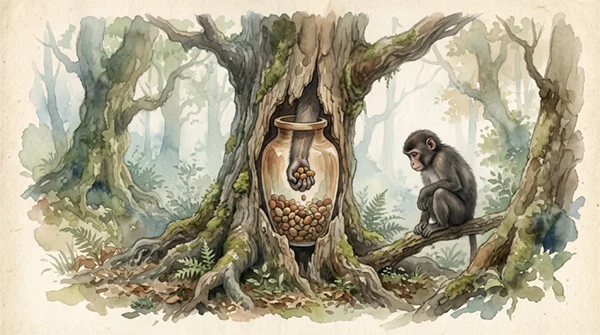
To see how this thirst traps us, consider a traditional method used by hunters in ancient Asia to catch monkeys without harming them:
A hunter takes a heavy jar with a narrow neck and secures it firmly to the base of a tree. Inside the jar, he places a handful of sweet, fragrant roasted peanuts. A curious monkey swings down, smells the delicious treat, and slips his open hand smoothly into the narrow neck of the jar. He grabs a big, tight fistful of peanuts. But when he tries to pull his hand back out, he finds that his closed fist is too large to fit through the narrow opening. He is stuck. The hunter walks out of the bushes, carrying a net. The monkey panics. He screeches and pulls frantically, but he refuses to let go of the nuts. The opening of the jar isn't holding the monkey; the monkey’s own grasp is holding the monkey. All he has to do to find total freedom is open his hand and let go of the bait. Yet, driven by the intense thirst of his appetite, he stays trapped.
We often act just like that monkey. Our fistfuls of peanuts are our expectations, our desires, and our need to be right. We complain about our entrapment, yet we refuse to simply open our hand.
The Modern Trap: The Compulsive Scroll
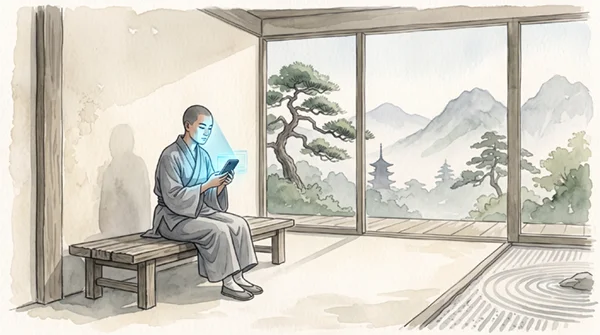
Let's look at a modern jar we all carry in our pockets: the smartphone.
Imagine you feel a sudden wave of boredom or a slight pang of loneliness on a quiet afternoon. Without even thinking, your hand reaches out, unlocks your phone, and opens a social media app. You find yourself scrolling compulsively, seeking a like, a comment, a funny video, or a piece of breaking news.
What is actually happening in the mind?
That momentary discomfort of boredom is a small instance of $Dukkha$. Instead of allowing the boredom to simply sit there, $Taṇhā$ kicks in as a powerful thirst. It demands: "Make this unpleasant feeling vanish right now! Give me validation! Give me distraction!" So you grab the bait. But notice: after ten minutes of mindless scrolling, does the thirst disappear? No. It usually leaves you feeling even more scattered, restless, and empty. The jar has trapped you again.
Your Reflection Task for Today
Today, we are going to notice when we are closing our fist around the peanuts.
The "Pause and Investigate" Practice: Today, whenever you feel a strong, sudden urge to consume something, buy something online, or mindlessly scroll through your phone, halt your movement completely. Take three slow, conscious breaths. While breathing, peer directly inward at the urge and gently ask yourself: "What is the 'thirst' behind this action? What am I trying to run toward, or what am I trying to run away from?"
Do not judge yourself for having the thirst. Simply shining the light of your awareness onto your closed fist weakens its grip.
Practice opening your hand today, even just a fraction. I look forward to seeing you tomorrow, when we explore what happens when we finally let go.