28-Day Sanctuary · Session 27
Bodhisattva's Vow
Session 27 of the free Light of Dharma contemplative journey, combining Buddhist wisdom, daily-life reflection, and a gentle practice.
Welcome back, traveler. Take a gentle seat, let your posture settle, and drop your shoulders. Let us take a slow, deep breath together, feeling the lungs fully expand and then fully release.
We have spent twenty-seven days together climbing this mountain. We have learned to cultivate mindfulness, to calm our minds, and to look at reality with Right View ($Sammā-diṭṭhi$). Today, as we stand just one step away from the completion of our 28-day course, the Great Physician offers us his most radical medicine. He teaches us the art of $Upāya$, or Spiritual Non-Attachment. He warns us not to turn the path of freedom into a new prison.
Day 27: The Raft and the River
The human mind has a powerful, deeply ingrained habit: whenever it finds something beautiful, comforting, or helpful, it immediately wants to grasp it, wrap its arms around it, and scream, "This is mine! I must hold onto this forever!"
Remarkably, we can even do this with spiritual practices. We can learn about mindfulness, compassion, or the Four Noble Truths, and instead of using them to free ourselves, we turn them into a rigid identity. We become attached to the labels, proud of our meditation streaks, and judgmental of those who do not practice.
But the Buddha taught that the Dharma—the teaching—is not a collection of absolute dogmas to be worshiped. It is a set of practical tools designed to do a specific job. Once the job is done, the tool must be gently laid down.
The Parable of the Raft

To ensure his students never became trapped by their own beliefs, the Buddha shared one of his greatest parables:
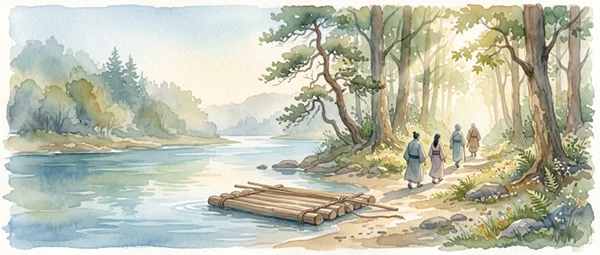
A traveler was on a long journey when he came to a vast, rushing river. The shore he stood on was dangerous, wild, and full of fear, but the distant shore across the water looked safe, peaceful, and free from peril. Seeing no bridge and no ferry, the traveler gathered branches, twigs, and reeds. He bound them tightly together, creating a sturdy, hand-built raft. Using his hands and feet to paddle, he safely crossed the raging current and arrived at the far shore. Stepping onto the dry, beautiful land, the traveler looked back at the dangerous river and thought, "This raft is incredible! It saved my life. I cannot simply leave it behind. I am going to hoist this heavy raft onto my shoulders and carry it on my back for the rest of my journey across the dry land." The Buddha looked at his disciples and asked, "If the man did that, would he be acting wisely?" "No, venerable sir," they replied. "Exactly," the Buddha smiled. "A wise traveler would leave the raft moored at the river's edge for the next person to use, and walk forward completely unburdened. In the same way, my friends, I have taught you the Dharma as a raft to cross over the river of suffering, not as something for you to carry on your back. You must let go even of good teachings, let alone harmful ones."
Dropping the Armor of Spiritual Pride

We see people carrying their rafts through the modern world all the time, often in the form of rigid identities or spiritual perfectionism.
Imagine you have completed a few weeks of mindfulness training. You feel calmer, you are sleeping better, and you are catching your stress early. One evening, you sit down for dinner with your family or friends, and they are behaving chaotically—complaining loudly about traffic, gossiping, or arguing over politics.
Let's watch a mind that is clinging tightly to its raft: Internal judgment flares up. A quiet, arrogant voice inside whispers, "Look at them, completely lost in their ego. If only they meditated like I do, they wouldn't be so reactive. They are so un-mindful."
In that split second, you have taken the beautiful raft of mindfulness and turned it into a heavy wooden weapon to smash over others. You are no longer fluid, loving, or present; you are rigid, tense, and full of spiritual pride.
Spiritual non-attachment means letting go of the need to look like a "perfect meditator." You drop the judgment, step off the pedestal, and simply meet your loved ones exactly where they are with an open, loving heart. You realize that the ultimate proof of a good practice is not how long you can sit on a cushion, but how deeply you can love the messy, imperfect world around you.
Your Reflection Task for Today
Today, we practice the art of unclenched hands, allowing our minds to become completely flexible and spacious.
The "Open Palm" Practice: Sometime today, notice where you are being rigid, stubborn, or attached to a specific concept—whether it is a spiritual rule, a professional dogma ("This is the only right way to run this project"), or a personal expectation of how someone else should behave. The moment you feel that tight, defensive, right-and-wrong contraction in your chest, visualize yourself standing on the shore, gently letting go of the raft. Take a deep breath, soften your body, and silently say to yourself: "The teaching is just a vehicle, not a prison. I choose to open my hand and be fluid."
True freedom is not about finding a perfect set of beliefs to cling to; it is having the courage to carry no heavy burdens at all.
Go lightly into your day today, traveler. Tomorrow, we gather for our final session to integrate everything we have learned.