28-Day Sanctuary · Session 23
River of Change
Session 23 of the free Light of Dharma contemplative journey, combining Buddhist wisdom, daily-life reflection, and a gentle practice.
Welcome back, traveler. Take a gentle seat, let your posture settle into a stable, comfortable alignment, and drop your shoulders. Let us take a deep, slow breath together, letting the air completely fill your chest before releasing it fully.
Over the past few days, we have acted as the wise watchmen of our awareness, mapping the body, the feelings, and the passing clouds of the hindrances ($Dhammānupassanā$). Today, we learn how to collect our scattered energies and mold them into an extraordinary tool for clarity and peace: $Sammā-samādhi$, or Right Concentration.
Day 23: Gathering the Rays
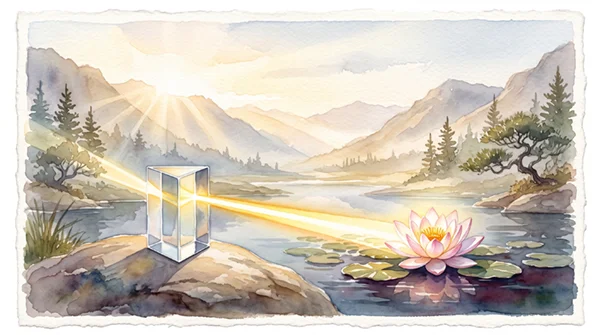
Have you ever noticed how exhausting it is to live in the modern world? On an ordinary day, our attention is split into a thousand tiny fragments. We are listening to a podcast while making breakfast, checking a message while crossing the street, and thinking about tomorrow's schedule while talking to a loved one. The mind becomes like a weak, flickering light bulb, throwing dim illumination in every direction but deeply penetrating nothing.
The Buddha taught that a scattered mind is an unpeaceful mind. The remedy is $Samādhi$, which literally means "bringing together" or "unification." Right Concentration is the art of developing a one-pointed mind.
Think of ordinary sunlight. It falls gently upon the earth, warming your skin but remaining perfectly harmless. However, if you place a simple magnifying glass between the sun and the ground, those scattered rays are gathered and condensed into a single, intensely focused point. That quiet beam suddenly possesses the power to cut through wood or ignite a fire.
Your awareness operates the exact same way. When you gather the scattered rays of your attention and rest them completely on a single object, the mind gains an immense, piercing clarity that can slice right through the thickest roots of suffering.
The Archer’s Narrowed Vision
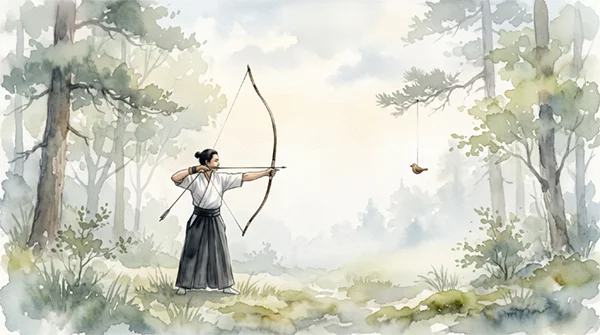
To understand what this unified focus feels like, the ancient masters often pointed to the training of elite warriors:
A legendary archery master called his disciples together for an examination. He hung a small wooden bird from a high branch of a distant tree and told them to aim directly at its eye. Before allowing the first disciple to shoot, the master asked, "Tell me, what do you see?" The disciple replied, "Master, I see the blue sky, the white clouds, the beautiful green leaves of the tree, and the wooden bird on the branch." The master sighed. "Step aside. You are not ready." He called the next disciple forward. "What do you see?" The second student replied, "I see the trunk of the tree, the branches, and the bird itself." The master shook his head. "Step aside." Finally, he called his most advanced student. "And you, what do you see?" The student drew his bowstring tight, his posture entirely frozen, and whispered, "I see only the eye of the bird." The master smiled. "Do you see the tree or my face?" "No, Master," the student replied, "I see nothing but the eye." "Shoot," said the master. The arrow flew true, piercing the tiny target instantly.
This is the essence of $Samādhi$. It is not a state of tense straining, but a beautiful, natural narrowing of the lens until the entire universe quietens down, leaving only the object of your attention.
Entering the Living Stream: The Modern Flow State
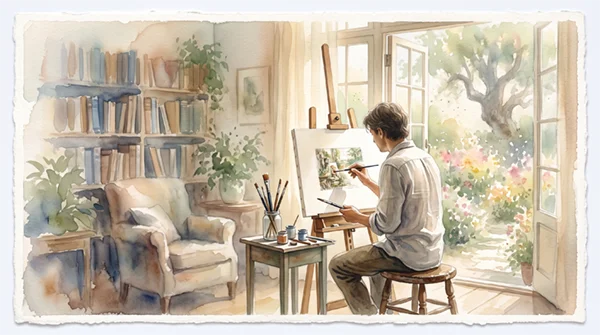
We do not need a bow and arrow to experience this beautiful unification. You have likely experienced moments of natural concentration in your own life without realizing it.
Think of a time when you were completely absorbed in a creative task—perhaps you were painting a picture, writing a piece of music, coding a complex software program, or simply getting completely lost in a brilliant book.
Remember how the world around you seemed to gently recede. You forgot about the clock. You didn't notice the traffic outside or the minor ache in your lower back. Your phone vibrated on the desk, but you didn't even hear it. You entered what modern psychology calls a "flow state," and what the Buddha called a state of absorption.
Notice how you felt when you finally stepped out of that deep focus. You didn't feel exhausted; you felt deeply refreshed, centered, and peaceful. Why? Because for a brief window of time, the restless, chattering ego was completely put to rest. The mind stopped fighting reality because it was entirely occupied by the beauty of a single point.
Your Reflection Task for Today
Today, we are going to intentionally build our own magnifying glass, training the muscle of concentration through a simple, beautiful discipline.
The 10-Minute Focus Practice: Sometime today, carve out exactly ten minutes of undisturbed quiet. Sit comfortably, keep your back straight, and choose one single anchor for your mind. This could be a candle flame, a small physical object on your desk, or simply the physical sensation of your breath at the tip of your nose. Set a timer. For those ten minutes, make a single, absolute commitment to your heart: "Every single time my mind wanders away to a thought, a worry, or a memory, I will gently, without a shred of frustration, bring it right back to this anchor."
Expect your mind to drift—that is what minds do. Every time you catch it wandering and guide it back, you are pressing the magnifying glass closer to the focal point. Celebrate each return as a victory.
Go into your day with a unified heart. I will be waiting for you right here tomorrow.