28-Day Sanctuary · Session 22
Mirror of Mind
Session 22 of the free Light of Dharma contemplative journey, combining Buddhist wisdom, daily-life reflection, and a gentle practice.
Welcome back, traveler. Take a gentle seat, let your feet connect firmly with the floor, and drop your shoulders. Let us take a slow, deep breath together. Yesterday, we sat back in the theater of consciousness to mirror the mind itself ($Cittānupassanā$). Today, we step into the fourth and final foundation of mindfulness: $Dhammānupassanā$, or Mindfulness of Mental Realities.
We are going to learn how to identify the subtle intruders that consistently hijack our peace.
Day 22: Unraveling Mental Patterns

Up to this point, we have mapped our body, our raw feelings, and our general moods. But as you sit in meditation or try to live mindfully, you will notice that certain repetitive, universal mental traps arise again and again to throw you off balance.
The Buddha, acting as the ultimate psychologist, categorized these traps into The Five Hindrances. These are not moral failures; they are simply temporary clouds that block the natural clarity of your mind.
When we look through the lens of $Dhammānupassanā$, our job is to recognize which of these five forces is active in the moment:
- Sensual Desire ($Kāmacchanda$): The restless pulling toward immediate pleasure, distraction, or comfort.
- Ill Will ($Vyāpāda$): The pushing away of reality through irritation, resentment, or anger.
- Sloth and Torpor ($Thīna-middha$): A heavy, sluggish fog of sleepiness, laziness, or mental boredom.
- Restlessness and Worry ($Uddhacca-kukkucca$): A scattered, buzzing energy—the "monkey mind" spinning about the future or rewinding the past.
- Skeptical Doubt ($Vicikicchā$): A paralyzing inner critic that whispers, "This is too hard. I can't do this. This mindfulness practice isn't working."
The Parable of the Wise Gatekeeper

To understand how to handle these hindrances, consider how ancient cities protected themselves from hostile forces:
A prosperous city is surrounded by a massive stone wall with a single, main wooden gate. Stationed at this gate is a wise, highly alert watchman. The watchman doesn't run out into the wilderness to fight every traveler approaching the city. Nor does he sleep at his post and let anyone walk right in. Instead, he stands steady, eyes wide open. When a traveler approaches, the watchman immediately inspects them. If an armed bandit arrives, the watchman doesn't panic; he simply recognizes them, shuts the gate, and calls out: "I see you, bandit. You cannot enter here." Because the bandit has been spotted and exposed, he loses the element of surprise, grows discouraged, and eventually turns around and leaves.
You are the watchman. The gate is your awareness. Your only job is to recognize the intruders the moment they show up at the door.
The Anatomy of a Derailed Afternoon
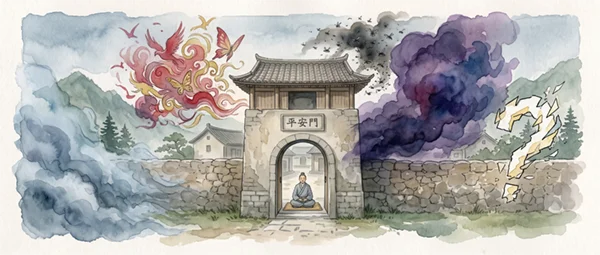
Let's look at how these bandits break into our modern city gates when we are off guard.
Imagine it is Tuesday afternoon. You have a vital, complex project due tomorrow that requires your absolute focus. You sit down, open your document, and tell yourself, "Okay, two hours of solid work starts now."
Let's watch the hindrances strike:
- Ten minutes in, the project gets slightly difficult. Instantly, Sloth arrives as a heavy wave of mental boredom. Your brain feels foggy.
- To escape the boredom, Sensual Desire slips in. Your hand reaches for your phone to check social media or look at a snack in the kitchen.
- You catch yourself and put the phone down, but now Restlessness takes over. Your mind begins buzzing: "I have so much to do. Did I reply to that text? What am I making for dinner?"
- Finally, as you look at the blank page, Doubt whispers: "I'm terrible at this. I'll never get this project done in time anyway."
Within twenty minutes, you haven't written a single word, and your energy is entirely drained. The bandits didn't just visit; they took over the castle.
Your Strategy to Dissolve a Hindrance Today
Today, we practice the art of the gatekeeper. We are not going to violently fight the hindrances; we are simply going to name them.
The "Name the Intruder" Practice: Sometime today, when you are trying to focus, rest, or meditate, you will feel yourself get derailed. Pause immediately, take a deep breath, and apply the R.A.I.N. technique to the hindrance:
- R – Recognize: Realize that a hindrance has arrived.
- A – Allow: Let it be there for a moment without fighting it or getting angry at yourself.
- I – Investigate: Look closely at how it feels in your body. Is it a tightening in the chest (Restlessness)? A heaviness in the eyes (Sloth)?
- N – Name/Non-identify: Give it a simple, direct label. Silently say: "Ah, this is Restlessness," or "Ah, this is Sloth."
The moment you explicitly name a hindrance, you strip away its mask. You realize it isn't your mind; it is just a passing cloud. Stand firm at your gate today. I will see you tomorrow for Day 23.