28-Day Sanctuary · Session 20
Calm Abiding
Session 20 of the free Light of Dharma contemplative journey, combining Buddhist wisdom, daily-life reflection, and a gentle practice.
Welcome back, traveler. Take a comfortable seat, soften your eyes, and allow your body to drop into a natural, steady posture. Let us take a slow, deep breath together. Yesterday, we explored the solid landscape of the physical body ($Kāyānupassanā$). Today, we step into the second foundation of mindfulness, moving a layer deeper into the subtle machinery of how we experience life.
Day 20: The Flavor of Feeling ($Vedanānupassanā$)

Today, we explore a concept that acts as the primary steering wheel for almost all human behavior, yet most people are entirely unaware it exists. The Buddha called it $Vedanā$, which is translated into English as "feeling tone" or "vedana."
When we hear the word "feeling" in the West, we usually think of complex, psychological emotions like jealousy, pride, or grief. But the Great Physician used $Vedanā$ to describe something much more primitive: the raw, instantaneous energetic flavor of an experience before the mind ever labels it or builds a story around it.
Every time a sight hits your eyes, a sound strikes your ears, or a thought crosses your mind, your nervous system automatically registers one of three primitive tones:
- Pleasant: A subtle internal "green light" that pulls us forward.
- Unpleasant: A subtle internal "red light" that pushes us back.
- Neutral: A gray zone that we usually ignore or sleepwalk through.
This tiny, split-second reaction is where $Taṇhā$ (thirst) is born. If a sensation is pleasant, we instantly grasp for it. If it is unpleasant, we instantly fight it. By learning to observe $Vedanā$ ($Vedanānupassanā$), we catch the spark before it becomes a raging emotional wildfire.
The Parable of the Orchard Master
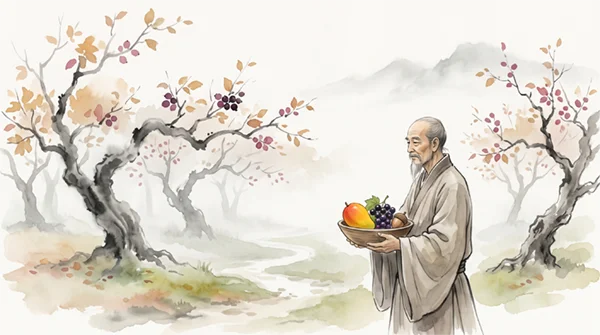
To understand how a wise mind relates to these shifting tones, consider this traditional illustration:
A wise master walks through a sprawling, ancient fruit orchard. As he walks, he reaches out and picks a ripe mango. It is perfectly sweet, bursting with juice. He tastes it, appreciates its delicious sweetness, and smiles. A few steps later, he plucks a wild berry. He bites into it, and it is incredibly sour and bitter, making his mouth pucker. He experiences the sourness fully, without a single illusion. But he does not throw a tantrum, smash the tree in anger, or curse the soil. Finally, he picks a plain, starchy seed. It has almost no flavor at all—completely neutral. He chews it mindfully, fully aware of its plainness. The orchard master travels through the entire grove enjoying the variety, never demanding that the sour berries become sweet, and never weeping when the sweetness of the mango fades from his tongue. He remains a free man.
Most of us spend our lives violently shaking the trees, desperate to scrub every sour berry out of existence, trapped by our own appetites.
How a Cold Draft Turns into an Office Feud
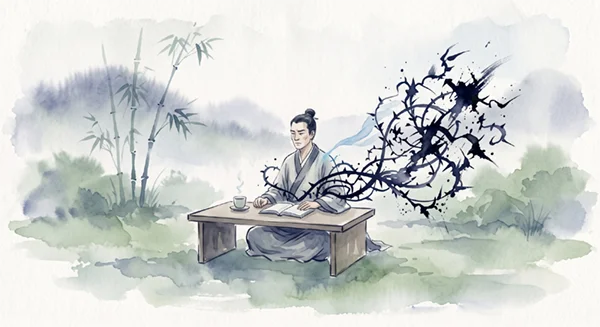
Let's look at how a lack of awareness around $Vedanā$ can quietly sabotage an ordinary workday.
Imagine you are sitting in a conference room during a team meeting. The air conditioning vents suddenly click on, and a blast of chilly air blows directly onto the back of your neck.
Let's watch the automated script play out in an unmonitored mind:
- The Sensation: Cold air touches skin.
- The $Vedanā$: Your nervous system instantly registers this sensation as unpleasant.
- The Story (The Trap): Because you aren't paying attention to the raw flavor of the feeling, your mind immediately creates a massive narrative around it: "This room is freezing. Why does facilities always keep the building like an icebox? It’s so disrespectful. And look at Dave over there, he looks perfectly fine. He probably set the thermostat himself just to annoy me."
By the time the meeting ends, you are clenching your jaw, glaring at Dave, and speaking with a sharp, passive-aggressive bite. A simple, raw physical sensation of coolness was allowed to morph into full-blown interpersonal anger—all because you didn't catch the unpleasant $Vedanā$ at the door.
Your Reflection Task for Today
Today, we are going to act as the objective scientists of our own sensory experience, separating the raw flavor from the mental fiction.
The "Flavor-Labeling" Practice: At five distinct points today—perhaps when you take your first sip of coffee, when a phone alarm goes off, when you feel a minor ache in your back, or when you look at a text message—pause instantly. Drop below the thoughts and label the experience purely by its raw hedonic tone. Silently say to yourself:
- "Pleasant"
- "Unpleasant"
- "Neutral"
Notice how the moment you label a sensation as simply "unpleasant," it loses its power to make you angry. You realize it is just a passing flavor on the tongue of consciousness.
Navigate your orchard with balance today. I will be waiting for you right here tomorrow.