28-Day Sanctuary · Session 2
Embracing Friction
Session 2 of the free Light of Dharma contemplative journey, combining Buddhist wisdom, daily-life reflection, and a gentle practice.
Welcome back, traveler. Take a moment to settle into your posture, soften your gaze, and notice the simple rhythm of your breathing. You survived yesterday’s diagnosis, and today we step together into the treatment room to look closely at the very first truth.
Day 2: Embracing Life's Friction ($Dukkha$)
Yesterday, we introduced the Buddha's primary diagnosis of the human condition: $Dukkha$. This ancient Pali word is traditionally translated into English as "suffering." Unfortunately, that translation can make Buddhism sound incredibly cynical or pessimistic, as if the path implies that life is purely miserable.
But the Buddha was a realist, not a pessimist. To truly understand $Dukkha$, it helps to look at the literal mechanics of the word in ancient India.
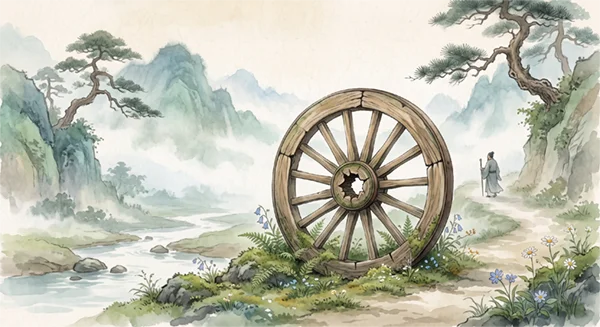
In the Buddha's time, $Dukkha$ was used to describe a chariot wheel whose axle hole was slightly off-center or warped. When a wheel is out of alignment, the chariot can still move forward, but every single rotation produces a jarring, bumpy, uncomfortable ride.
$Dukkha$ is not just intense agony; it is that subtle, ambient friction of existence. It is the underlying unsatisfactoriness we feel because everything around us—and within us—is constantly changing. Even our happiest moments have a shadow of $Dukkha$, because we instinctively know those moments will eventually end.
The Story of Kisa Gotami and the Mustard Seed
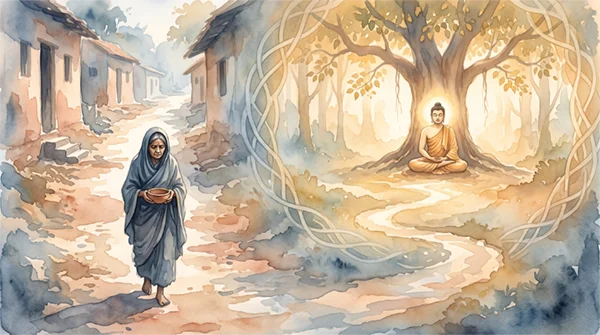
To understand how universal this friction is, we remember the story of a young mother named Kisa Gotami:
Kisa Gotami gave birth to a beautiful baby boy, but before the child could walk, he fell ill and died. Overwhelmed by agonizing grief, Kisa Gotami could not accept the reality. She carried her dead child in her arms from house to house, begging her neighbors for medicine to cure him. People thought she had lost her mind. Finally, a wise man directed her to the Buddha. She ran to him, weeping, and pleaded, "Great Physician, give me the medicine that will restore my son!" The Buddha looked upon her with boundless compassion and said, "I can heal your child, but I need a specific ingredient. Bring me a handful of mustard seeds. However, the seeds must come from a home where no one has ever lost a child, a spouse, a parent, or a friend." Heartened, Kisa Gotami rushed back to the village. She knocked on the first door. "Can you give me a handful of mustard seeds?" she asked. "Of course," the neighbor replied. But when Kisa Gotami asked, "Has anyone died in this house?" the neighbor sighed. "Alas, the living are few, but the dead are many. My grandfather passed away last winter." She went to the next house, and the next, and the next. In every single household, the story was the same. One home had lost a daughter; another, a husband; another, a beloved servant. By evening, the truth finally dawned on her tired mind. She realized she was not alone in her grief; pain and loss are woven into the very fabric of human life. Gently laying her child to rest, she returned to the Buddha. "Have you brought the mustard seeds?" he asked. "No," she replied softly, "but I have understood your medicine."
The Bittersweet End of a Perfect Sunday

We don't just experience $Dukkha$ during immense tragedies like Kisa Gotami's. We experience it in our everyday comforts.
Imagine it is a beautiful Sunday evening. You are sitting on your couch, holding a warm cup of your favorite tea, watching a breathtaking sunset out the window. Everything is utterly perfect.
But suddenly, a thought creeps in: "Tomorrow is Monday. I have to go back to work. This weekend went by way too fast." In an instant, your chest tightens slightly. The perfection of the sunset is dimmed by the anticipation of its ending. That tiny pang of premature nostalgia, that subtle resistance to the passage of time—that is $Dukkha$. It is the wheel of the mind hitting a bump because it is clinging to a fleeting moment, demanding that it stay still.
Your Reflection Task for Today
Today, we practice not turning away from the friction, but meeting it with a gentle, curious smile.
The "Notice the Friction" Practice: Today, actively watch for three instances of subtle friction in your day. It could be the irritation of a slow internet connection, the minor disappointment of dropping a pen, or the anxiety of a passing thought. When you feel that internal bump, do not react with anger or try to force it away. Instead, take a soft breath and silently say to yourself: "Ah, there it is. This is just the wheel slightly out of alignment. This is Dukkha."
By observing the friction without reacting to it, you stop fighting reality. And in that space of non-resistance, true peace begins to bloom.
Be gentle with yourself today. I will be waiting for you tomorrow, when we examine why this friction happens in the first place.