28-Day Sanctuary · Session 18
Flow of Feelings
Session 18 of the free Light of Dharma contemplative journey, combining Buddhist wisdom, daily-life reflection, and a gentle practice.
Welcome back, traveler. Take a gentle seat, let your posture settle, and drop your shoulders. Let us take a deep, slow breath together. Yesterday, we learned the importance of tuning our inner strings with Right Effort ($Sammā-vāyāma$), making sure our minds are neither too tight with strain nor too loose with laziness. Today, we look at the specific home where we can let those strings rest.
We enter the practice of $Ānāpānasati$, or Mindfulness of Breathing.
Day 18: Home in the Present: The Anchor of Breath Mindfulness
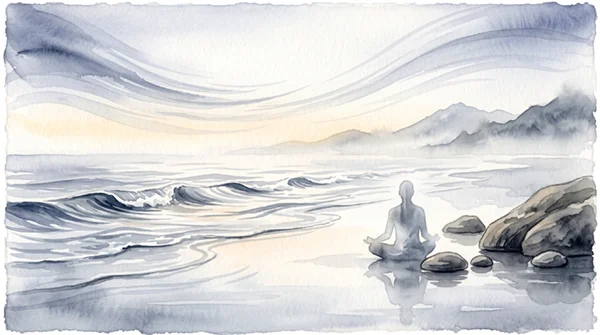
When you look at an untrained human mind, it looks remarkably like a stormy sea—restless, erratic, and constantly tossed about by the winds of thoughts, worries, and reactions. To bring stability to this chaos, the Great Physician did not give us a complex philosophical theory. He gave us something you carry with you every second of your life: your breath.
In the Satipaṭṭhāna Sutta (the Discourse on the Foundations of Mindfulness), the Buddha details the core mechanics of how we use the breath to anchor our awareness. He notes that the practice is built upon clean, objective tracking:
- When breathing in a long breath, you know: "I am breathing in a long breath."
- When breathing out a long breath, you know: "I am breathing out a long breath."
- When breathing in a short breath, you know: "I am breathing in a short breath."
This is not about changing your breath or forcing it into a mechanical rhythm. It is about learning to ride the natural wave of your respiration exactly as it is. Your mind cannot think two thoughts simultaneously. By filling the theater of your consciousness with the raw physical sensations of the breath, you leave no room for the loops of anxiety, regret, or calculation to take root. The breath becomes your ultimate sanctuary—a home base in the present moment.
The Parable of the Wild Stallion
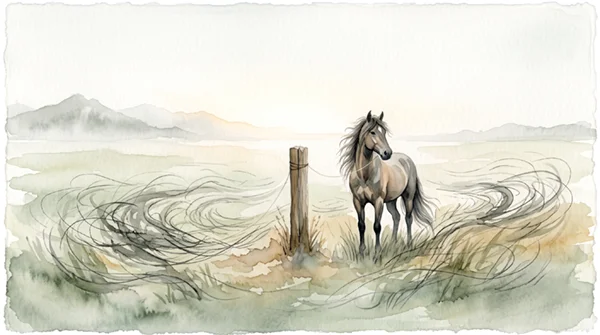
To understand how a wise meditator relates to a chaotic mind, consider this traditional illustration:
A nomadic herder encounters a magnificent, powerful wild stallion out on the plains. The horse is wild with untamed energy, kicking its hooves and charging in every direction. The herder wishes to tame the stallion, but he does not hit it with a whip or try to lock it instantly inside a tight, tiny cage; doing so would only break its spirit or make it turn violent. Instead, the herder takes a long, strong, yet incredibly soft rope. He loops one end gently around a heavy wooden post planted deep into the earth, and the other end loosely around the stallion's neck. At first, the horse panics. It bolts to the left, but the rope grows taut, and it stops. It rears up and runs to the right, but the post holds firm. Hour after hour, the stallion tests the boundaries of the rope, running in frantic circles. Throughout the entire process, the post remains completely steady, and the rope remains soft. Eventually, realizing it cannot pull the post out of the earth, the stallion tires itself out. It slows down, steps closer to the post, lowers its head, and stands perfectly still in a state of calm, cooperative majesty.
The wild stallion is your untamed mind. The sturdy wooden post is the present moment. And the soft, strong rope is your mindful awareness of the breath. Every time your mind bolts toward a worry, do not pull violently or beat yourself up with judgment. Simply use the soft rope of the breath to guide it back to the post.
Grounding the Internal Emergency: An Office Panic Attack
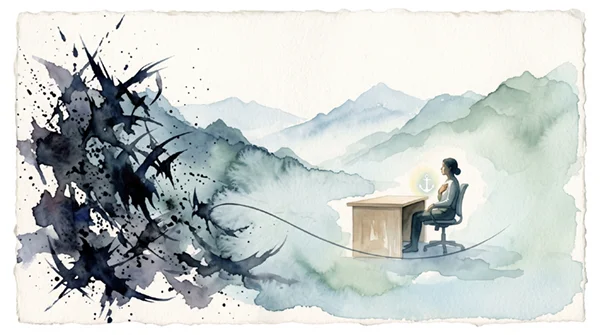
Let us look at how this soft rope saves us during a modern moment of crisis.
Imagine you are sitting at your desk, and you receive an unexpected message that a vital presentation has been pushed up to start in exactly five minutes. Instantly, your body interprets this as a physical emergency. A wave of adrenaline floods your system. Your heart begins to violently beat against your ribs, your vision narrows, your hands grow cold, and a suffocating tightness locks around your chest. You are in the grips of an acute anxiety attack.
If you let the stallion run wild, your mind screams: "I'm going to ruin this! I'm completely unprepared! I can't breathe!" This mental panic signals your body to pump out even more adrenaline, creating a terrifying, self-fulfilling downward spiral.
This is the exact moment to drop everything and drop below your thinking mind. You don't try to solve the presentation problem yet. You close your eyes, place your hand flat against your stomach, and bring your full, laser-focused attention to the sensation of your breathing.
You take a slow, deep inhalation, tracking the cool air passing through your nostrils. Then, you make the exhalation twice as long as the inhalation, feeling your abdomen fall and your chest drop. By tracking the physical reality of three long, slow breaths, you send a direct neurological message to your brain: "There is no physical tiger chasing us. We are safe in this chair." Your heart rate naturally begins to drop, the chest expands, and you step into the meeting room not from a place of panic, but from a baseline of calm, precise clarity.
Your Actionable Meditation Guide: The 10-Minute Daily Sitting
Today, your task is to step onto the cushion or pull up a quiet chair to plant your own wooden post.
- Settle Your Form: Find a quiet space and sit comfortably for 10 minutes. Keep your back upright but completely relaxed. Place your hands gently on your lap. Close your eyes or lower your gaze to a soft point on the floor ahead.
- Find Your Anchor: Take two deep, cleansing breaths. Then, let your breathing return to its completely natural, automated rhythm. Scan your body and pick one specific location where the physical sensation of the breath is clearest to you. This might be the cool tickle of air at the rim of your nostrils, the rising and falling of your chest, or the expansion and contraction of your belly. This spot is your anchor.
- Track the Sensation: For the remainder of the 10 minutes, keep the spotlight of your attention pinned to that exact spot. Feel the raw sensations—the movement, the stretch, the subtle temperature changes.
- The Soft Return: Your mind will wander to thoughts, sounds, or tasks. This is normal. The moment you catch the horse running away, do not judge yourself. Simply note "thinking" or "worrying," and gently guide your attention right back to the physical sensation of the next inhalation.
Every time you bring the mind back, you are strengthening the loop of the soft rope. Go into your day with the grounding strength of the breath. I will be right here waiting for you tomorrow.
Continue with established sources
Further reading
Open complete translations and specialist reference material for deeper study.
- SN 36.6 · An Arrow
SuttaCentral · Bhikkhu SujatoCompare the full Two Arrows discourse with notes and parallel-text navigation.