28-Day Sanctuary · Session 17
Silent Witness
Session 17 of the free Light of Dharma contemplative journey, combining Buddhist wisdom, daily-life reflection, and a gentle practice.
Welcome back, traveler. Take a gentle seat, let your feet rest firmly on the floor, and let us take a slow, deep breath together. Yesterday, we learned to stand firm like an unshakable mountain amidst the shifting winds of life ($Upekkhā$). Today, we transition into the final major division of our 28-day course: the cultivation of the mind itself through meditation and mental discipline. Let us explore the engine that drives this entire path forward.
Day 17: Channeling Energy: Right Effort ($Sammā-vāyāma$)
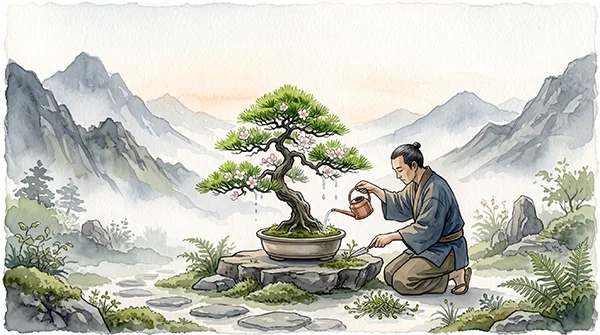
When people begin to practice mindfulness, they often fall into one of two traps. Some think that meditation means doing absolutely nothing—just sitting passively and letting the mind wander wherever it wants. Others treat meditation like an intense corporate boot camp, trying to aggressively crush their thoughts through sheer willpower.
The Buddha rejected both extremes. He taught $Sammā-vāyāma$, or Right Effort. Right Effort is the conscious, intelligent channeling of your mental energy. It is not a violent struggle; it is the art of wise gardening. You do not yank at a plant to make it grow faster, nor do you leave the garden entirely to the weeds. You skillfully cultivate the soil.
The Great Physician broke this mental cultivation down into four precise tasks:
- Preventing: Guarding the mind so that new negative, unwholesome states (like rage, greed, or despair) do not take root.
- Abandoning: Gently letting go of any negative, unwholesome states that have already arisen, rather than feeding them.
- Cultivating: Inviting new positive, wholesome states (like kindness, presence, and clarity) to bloom in the mind.
- Maintaining: Nourishing and protecting the positive, wholesome states that are already present so they can grow to full maturity.
The Parable of the Over-Tuned Lute

To understand the delicate balance required for Right Effort, listen to the advice the Buddha gave to a young monk named Soṇa, who had been a professional musician before ordaining:
Soṇa was practicing walking meditation so intensely that his feet began to bleed, yet his mind remained restless and frustrated. He thought about giving up the path entirely. Recognizing his distress, the Buddha went to visit him and asked, "Soṇa, when you lived at home, you were a skilled player of the lute, were you not?" "Yes, venerable sir," Soṇa replied. "Tell me, Soṇa, when the strings of your lute were tuned too tightly, was the instrument playable? Was the music beautiful?" "No, sir. The strings would snap, and the sound was harsh." "And when the strings were completely loose and slack, was the music beautiful then?" "No, sir. The strings would not vibrate properly, and it would produce no useful sound at all." "Exactly," the Buddha said gently. "In the same way, Soṇa, when effort is applied too intensely, it leads to restlessness. When effort is too slack, it leads to laziness and drift. Tune your effort to the middle capacity, match it to your inner strings, and you will find your rhythm."
Shifting Out of the Downward Spiral
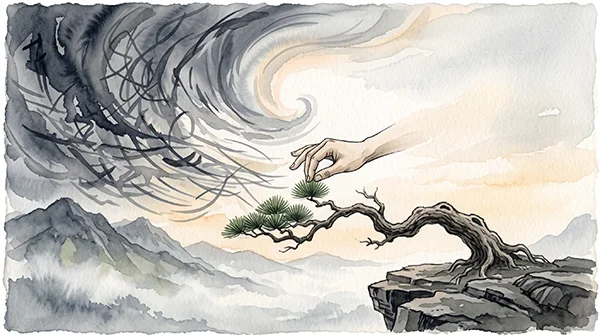
Let's look at how we tune our mental strings during a standard, modern day.
Imagine you are working on a report, and you make a minor mathematical error that your supervisor politely points out. Instantly, an unwholesome seed is planted. Your mind begins a downward spiral: "I am so careless. I always mess up details like this. My boss probably thinks I'm incompetent. I'm going to get passed over for that bonus, and then..."
Without Right Effort, you let this unwholesome state run wild (failing Task 2). The string is tuned way too tight, vibrating with anxiety.
Applying Right Effort means catching that thought pattern early. You notice the tightening in your chest. Instead of feeding the spiral, you take a slow breath and practice abandoning the unarisen disaster scenario. You say to yourself, "Ah, that's just an anxious loop. It's just a minor typo." Then, you smoothly transition to cultivating a wholesome state—you remind yourself of a project you handled beautifully last week, or you simply direct your full, calm attention back to the present task. You tune the string back to the middle space.
Your Reflection Task for Today
Today, we are going to act as the wise musicians of our own minds, checking the tension of our inner strings.
The "Catch and Tune" Practice: Today, watch your mind for the very first signs of a negative thought pattern—whether it is a wave of irritation, a cycle of self-criticism, or a cloud of boredom. The moment you catch it, pause. Take a soft, centering breath. Rather than fighting the thought or judging yourself for having it, gently redirect your focus toward something wholesome. You might look out the window at a tree, recall a recent moment of gratitude, or simply bring your full, exquisite awareness to the physical sensation of your hands resting on your desk.
Practice tuning your mind today—not too tight, not too loose. I will be right here waiting to walk with you tomorrow.