28-Day Sanctuary · Session 16
Anchor of Breath
Session 16 of the free Light of Dharma contemplative journey, combining Buddhist wisdom, daily-life reflection, and a gentle practice.
Welcome back, traveler. Take a gentle seat, let your spine grow tall and straight like a bamboo stalk, and drop your shoulders. Let us take a deep, slow breath together, letting the air completely fill your chest before letting it go.
Over the last three days, we have wandered through the beautiful dwellings of the heart: loving-kindness ($Mettā$), compassion ($Karuṇā$), and sympathetic joy ($Muditā$). Today, we complete this journey by entering the final, most majestic abode of them all—the foundation that keeps all the others from collapsing.
Day 16: The Unshakable Mountain: Equanimity ($Upekkhā$)
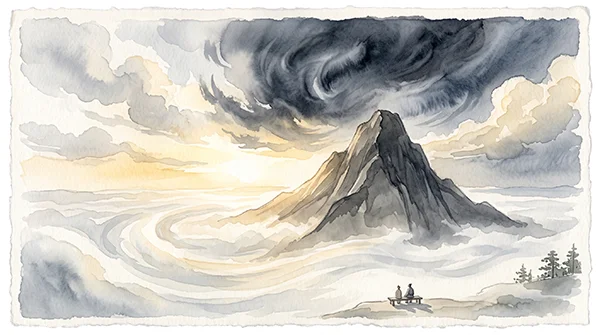
The fourth and final Brahmavihāra is $Upekkhā$, which is translated into English as equanimity.
Equanimity is often misunderstood. Some people think it means being cold, indifferent, or emotionally numb—like a stone that doesn't feel anything. But true equanimity is the exact opposite. It is a state of profound, spacious balance. It is a heart that is so wide, so deeply grounded, that it can hold all the joys and sorrows of life without being knocked off balance.
The Buddha taught that our minds are constantly buffeted by what he called the Eight Worldly Winds. These winds blow through every human life, shifting rapidly from moment to moment:
- Pleasure and Pain
- Gain and Loss
- Praise and Blame
- Fame and Disrepute
Most of our life is spent frantically chasing the positive winds and running away from the negative ones. When praise blows our way, we inflate with pride; when blame hits us, we collapse in despair. $Upekkhā$ is the practice of becoming like a majestic mountain. The weather changes—sometimes it is sunny, sometimes a violent storm rages—but the mountain remains completely unmoved.
The Zen Master's Refusal to Fight: "Is That So?"
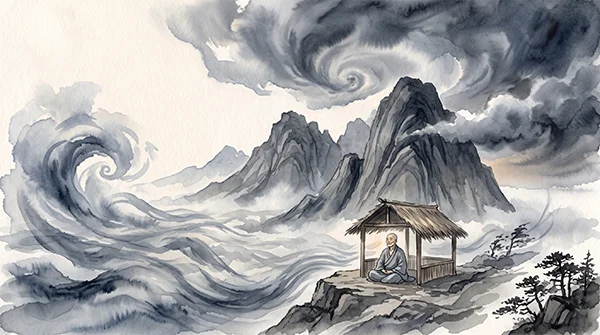
To understand the immense power of an equanimous mind, consider this classic story of a respected Zen master named Hakuin:
Hakuin lived in a small village where he was highly revered for his pure, spiritual life. One day, the teenage daughter of the local food merchants was discovered to be pregnant. Her furious parents demanded to know the identity of the father. Terrified of their anger, the girl lied and blurted out the first name that came to mind: "It was Hakuin!" The parents rushed to Hakuin’s hut, screaming insults and shouting that his reputation was ruined. The master did not panic, defend himself, or rage against the injustice. He listened calmly, and when they finished, he simply looked up and said: "Is that so?" When the baby was born, the parents dumped the infant on Hakuin’s doorstep, telling him he must raise it. By this time, Hakuin’s reputation was utterly destroyed; the villagers shunned him. Yet, without resentment, he accepted the baby, buying milk and caring for the child with deep tenderness. A year later, overwhelmed by guilt, the young mother finally confessed the truth: the real father was a young man from the fish market. The embarrassed parents hurried back to Hakuin's hut. They bowed down, begged for forgiveness, and asked for the baby back. Hakuin smiled gently, handed the child over to them, and as they apologized for the terrible mistake, he simply looked at them and said: "Is that so?"
Hakuin was an absolute mountain. The winds of blame and disrepute had blown, followed by the winds of praise and honor. Because he was grounded in reality rather than public opinion, his peace was never touched.
Staying Steady in the Corporate Storm
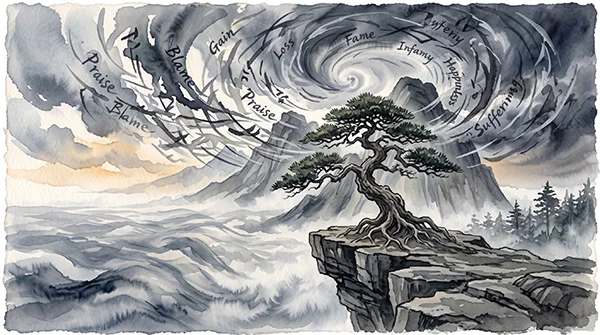
We encounter the eight worldly winds in our modern workspaces every week.
Imagine you have poured months of late nights and weekends into a massive, highly anticipated project. The day arrives to launch it or pitch it to executive leadership.
- Scenario A: The project is a spectacular failure. The technology glitches, or the client rejects it completely. The wind of Loss and Blame hits you.
- Scenario B: The project succeeds wildly. You receive a standing ovation, your inbox floods with congratulations, and your name is highlighted in the company newsletter. The wind of Gain and Praise arrives.
Without equanimity, both scenarios trap you. In Scenario A, you fall into deep anxiety, doubting your entire worth as a professional. In Scenario B, your ego balloons; you become intoxicated by the praise, setting yourself up for a painful crash later when the wind inevitably shifts.
Equanimity allows you to breathe through both. If the project fails, you sit steady, look at the data objectively, and ask, "What can I learn from this?" If it succeeds wildly, you accept the compliments with a warm smile, appreciate your team, and remain fully grounded. You enjoy the success, but your core identity doesn't depend on it.
Your Reflection Task for Today
Today, we are going to practice being the mountain in the middle of our own daily weather patterns.
The "Be the Mountain" Practice: Sometime today, an emotional storm will likely blow into your world. A client will send an annoying email, a family member will express disappointment, or a wave of anxiety will wash over you. The very moment you feel that internal emotional storm brewing, pause. Physically drop your shoulders, plant your feet firmly on the ground, and silently recite this phrase: "The weather is changing, but I am the mountain. Winds blow, but I remain steady."
Allow the feelings, thoughts, and external events to move around you like clouds passing over a peak. Notice how much room there is in your heart to let the world happen without being broken by it.
Go with the strength of the mountain today. I will be right here waiting for you tomorrow.