28-Day Sanctuary · Session 13
Compassion in Action
Session 13 of the free Light of Dharma contemplative journey, combining Buddhist wisdom, daily-life reflection, and a gentle practice.
Welcome back, traveler. Find a comfortable posture, let your hands rest gently on your lap, and take a long, refreshing breath. Yesterday we looked at how our intentions shape our world. Today, we open the door to the most beautiful mansion of the human heart.
Day 13: Radiant Kindness: Cultivating Loving-Kindness ($Mettā$)

Today, we cross a threshold into the traditional core of Buddhist emotional training. The Buddha taught that a liberated mind is not cold, detached, or clinical. Rather, it is warm, spacious, and intensely bright. He outlined four qualities of a awakened heart known as the Four $Brahmavihāras$—which translates to the "Sublime Abodes" or the "Divine Dwellings."
The very first of these four abodes is $Mettā$, which means loving-kindness or universal goodwill. $Mettā$ is not a soft, sentimental emotion, nor is it a requirement that you like everyone or agree with their behavior. $Mettā$ is an active orientation of the heart: the sincere, unconditional wish for all living beings to be safe, peaceful, and truly happy.
The Heart of the Mettā Sutta

In one of the Buddha’s most famous discourses, the Karanīyamettā Sutta (The Discourse on Loving-Kindness), he offered a profound image to describe the boundless capacity of our care:
"Whatever living beings there may be—whether they are weak or strong, omitting none, the great or the mighty, medium, short or small, the seen and the unseen, those living near and far away, those born and to-be-born—may all beings be at ease." "Just as a mother would protect her only child with her life, even so let one cultivate a boundless heart towards all beings. Let one’s thoughts of boundless love pervade the whole world—above, below, and all around—without any obstruction, without any hatred, without any enmity."
The Buddha was reminding us that our natural capacity to love and protect is immense. Usually, we reserve this fiercely protective care for a select few: our children, our partners, or our pets. The practice of $Mettā$ is the gradual process of widening that circle until no one is left outside.
Redefining the Morning Commute
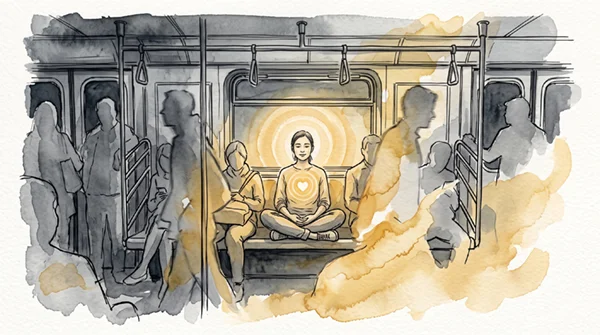
How do we take this lofty ideal and use it to transform an ordinary day?
Imagine you are sitting on a packed subway car or bus during the morning rush hour. Next to you is a stranger leaning heavily against your shoulder, scrolling aggressively on their phone. Across from you stands a coworker known for being difficult, critical, and short-tempered.
Your regular, uncultivated habit might be to stiffen your posture, build up a wall of irritation, and think, "I just want to be left alone." But choosing $Mettā$ changes the internal script entirely. You look at the stranger next to you, and instead of a nuisance, you recognize a human being who has their own hidden heartaches, their own stresses, and their own deep desire to arrive safely and feel happy. You look at your difficult coworker and realize that their abrasive behavior is simply the outward symptom of an unpeaceful mind—a person trapped by their own internal friction ($Dukkha$).
Silently, beneath the rumble of the train, you direct a quiet stream of goodwill toward them: "May you find ease. May you be free from stress." Suddenly, the atmosphere of your own mind completely shifts. You haven't changed their behavior, but you have thoroughly liberated yourself from the toxic poison of resentment.
Your 5-Minute Guided Micro-Meditation
Today, instead of a simple reflection task, we will practice a structured 5-minute micro-meditation. You can do this sitting quietly first thing in the morning, during a lunch break, or while waiting in a line.
Set a timer for 5 minutes, close your eyes, bring your attention to the center of your chest, and repeat these four classic phrases rhythmically:
- Direct the phrases to yourself: “May I be safe from internal and external harm.” “May I be healthy and strong.” “May I be peaceful and at ease.” “May I live happily in this world.”
- Direct the phrases to a Benefactor: Think of someone who has been deeply kind to you—a teacher, a grandparent, or even a beloved pet. Picture them smiling, and say: “May you be safe. May you be healthy. May you be peaceful. May you live happily.”
- Direct the phrases to a Neutral Person: Think of a stranger you see often but don't really know—the barista, a delivery driver, or a neighbor. Radiate the phrases to them.
- Direct the phrases to the World: Expand your awareness to your entire neighborhood, your city, and ultimately all living beings across the earth: “May all beings everywhere be safe, peaceful, and truly happy.”
Carry this radiant warmth with you today. I will meet you here tomorrow as we explore what happens when this kindness meets suffering.