28-Day Sanctuary · Session 11
Right Livelihood
Session 11 of the free Light of Dharma contemplative journey, combining Buddhist wisdom, daily-life reflection, and a gentle practice.
Welcome back, traveler. Take a moment to settle onto your cushion, let out a deep breath, and allow your hands to rest calmly on your lap. We have stood guard at the gateway of our speech and aligned our physical bodies with the law of harmlessness. Today, on our eleventh day, we bring the light of the Dharma directly into the space where we spend most of our waking lives: our work. Welcome to the study of Right Livelihood.
Day 11: Pure Livelihood: Right Livelihood ($Sammā-ājīva$)

For many of us, work is seen as a separate compartment of life. We think, "I do what I have to do to make a living from nine to five, and then I practice my spirituality or mindfulness in the evening." But the Great Physician completely dissolved this separation. Because our livelihood is a massive driver of our daily thoughts, intentions, and actions, the Buddha integrated Right Livelihood ($Sammā-ājīva$) into the core of the Noble Eightfold Path.
At its most fundamental level, Right Livelihood means earning our bread in a way that does not cause suffering, exploitation, or destruction to other living beings. In the ancient texts, the Buddha explicitly named five trades that a lay practitioner should avoid because their very nature requires harming others: trading in weapons, trading in human beings, trading in meat, trading in intoxicants, and trading in poisons.
But Right Livelihood is not just about what we do for a living; it is about how we do it. It is about bringing absolute integrity, honesty, and a spirit of service to your daily tasks. If you are a doctor who overcharges patients out of greed, or a salesperson who intentionally deceives clients to hit a quota, you are creating unwholesome karma ($Kamma$). Your work should be an extension of your practice, a way to heal the world rather than scratch it.
The Merchant and the Balanced Scales
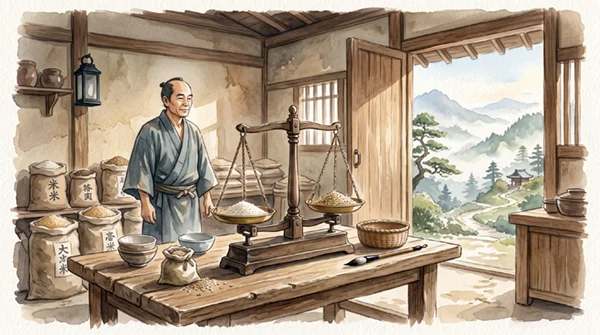
To understand how the Dharma can completely transform our relationship with our profession, let us listen to a traditional story from the merchant guilds of ancient India:
There was once a wealthy grain merchant named Dhanapāla who was notorious for his cunning business practices. He constructed a set of trick scales with a hollow, weighted beam. When he bought grain from poor farmers, the scale would tip to make their harvest look smaller, allowing him to pay them less. When he sold grain to the villagers, he would secretly flip a mechanism to make the grain weigh less, maximizing his profits. Dhanapāla was wealthy, but his mind was plagued by constant paranoia, anxiety, and sleepless nights. One afternoon, Dhanapāla happened to pass a park where a disciple of the Buddha was teaching the Dharma. He paused and heard these words: "Wealth gained through deception is like a burning coal wrapped in silk; it will eventually burn through its container and destroy the one who holds it." The words pierced Dhanapāla’s heart. Overcome with deep remorse, he returned to his shop and smashed his trick scales. He had a new set of scales forged—perfectly balanced and verified. He began to give fair weight to every farmer and customer, and he openly apologized to the village. His profit margins shrank, but something miraculous happened: the heavy, suffocating knot of anxiety in his chest vanished. He slept soundly for the first time in decades. He realized that the true profit of his trade was not the gold in his vault, but the unshakeable peace of a clean conscience.
Transforming the Standard Corporate Job

Let let us bring this down to a modern corporate office or service environment. You might think, "I am just a data analyst, a software engineer, or a customer service representative. How can my standard job become Right Livelihood?"
Imagine you work in customer service for a large telecommunications company. It is 4:00 PM on a grueling Thursday. You receive a call from an elderly customer who is confused by a sudden spike on their monthly bill. They are anxious, defensive, and speaking slowly.
Let us look at two ways to handle this call:
- The Unmindful Path: You feel a bump of irritation ($Dukkha$). Driven by the desire to keep your "average handle time" low and maintain your corporate stats, you rush them, use complex jargon to deflect the issue, or pass them off to another department. You get them off your line quickly, but you leave them confused and you leave yourself feeling hollow.
- The Path of Right Livelihood: You breathe, soften your shoulders, and view this call as a sacred moment of service. You listen patiently, walk them through the bill step-by-step with radical honesty, and genuinely advocate to get the erroneous charge removed.
Notice what happened here: you did not change your job description. You changed your intention. By infusing your standard corporate role with integrity, compassion, and presence, you turned a mundane task into a sanctuary of safety for that customer. Your work became a vehicle for the Dharma.
Your Reflection Task for Today
Today, we are going to look at our daily labor through the unclouded lens of our interconnected net.
The "Work with Ultimate Honesty" Practice: Before you begin your work today—or any primary daily task—pause for thirty seconds and ask yourself: "How does the output of my labor support or bring ease to the lives of others? How does it connect to the wider web of humanity?" Throughout this day, practice bringing ultimate honesty to your work. Do not cut corners out of laziness, do not misrepresent your progress to a manager or client, and treat every person you interact with online or in person as a fellow traveler worthy of your full respect.
As you close your laptop or finish your tasks this evening, check in with your mind. Notice the clean, cool sense of dignity that arises when your livelihood is completely aligned with your values.
Work beautifully today. I will be waiting for you tomorrow, as we enter the third week of our journey and step onto the Path of Mental Stability ($Samādhi$).